
| Client | Campaign scope | Primary conversion |
|---|---|---|
| ArangoDB | USA, UK, Germany, Italy and France | Free-trial registration |
| Business model | B2B; 201-500 employees | Lead forms and event registrations |
| Duration | More than 12 months; completed | 1–4-week typical sales cycle |
Executive summary
ArangoDB provides a multi-model database platform that brings graph, document and key-value data into one database. Its technology supports demanding use cases including artificial intelligence, analytics, fraud detection, knowledge graphs and enterprise data management.
Inboundsys was engaged to generate qualified free-trial sign-ups and enterprise interest among developers, technical teams and business decision-makers. The program began without historical campaign data, so the team had to establish the audience, keyword, conversion-tracking and optimization foundations from zero.
The business challenge
Enter a highly competitive, niche B2B database market where clicks can be expensive.
Reach genuine technical evaluators rather than broad, low-intent traffic.
Build keyword architecture, channel targeting and measurement without a prior performance baseline.
Generate qualified trials at a cost-effective CPA while supporting a longer enterprise buying journey.
Objectives and success criteria
| Objective | How success was assessed |
|---|---|
| Qualified demand | Free-trial registrations and lead quality from the sales team |
| Efficiency | Cost per acquisition, conversion rate and profitable scale |
| Engagement quality | CTR, conversion volume and technical audience relevance |
| Pipeline support | MQL generation and stronger alignment with enterprise sales goals |
Strategic principle
Prioritize qualified technical intent first; scale only after the search terms, audiences and conversion signals proved their value.
The strategy: one funnel, three channel roles
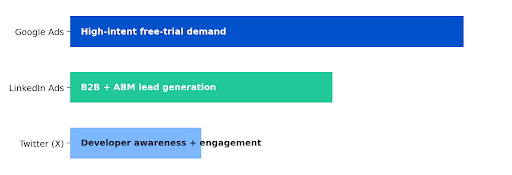
Each platform was assigned a distinct role so that high-intent capture, enterprise targeting and developer awareness worked together rather than competing for the same job.
Audience architecture
| Segment | Execution |
|---|---|
| Technical practitioners | Software developers, solution architects, data engineers and engineering managers |
| Enterprise decision-makers | Job title, function, seniority, industry and company-profile targeting |
| High-intent prospects | Search audiences, competitor audiences and users actively evaluating database solutions |
| Priority accounts | Contact lists, company lists and account-based marketing |
| Lifecycle audiences | Cold prospecting plus remarketing |
| Market segments | Geography, industry and job-role segmentation across five countries |
Offers and messaging
Free trial as the primary low-friction evaluation offer.
Event and webinar registration to educate prospects and create additional engagement.
A clear value proposition: graph, document and key-value data managed in one database.
Use-case relevance for AI, analytics, knowledge graphs and enterprise applications.
Benefit-led language and strong calls to action instead of overly technical creative.
Google Ads: capturing active demand
Google Ads was the primary conversion engine because it reached people actively searching for graph databases, multi-model databases, NoSQL solutions and enterprise database platforms. Search campaigns handled direct demand; YouTube expanded product understanding through video.
Campaign build
| Workstream | What Inboundsys implemented |
|---|---|
| Intent research | Keyword research, competitor research and search-intent mapping |
| Account structure | Tightly themed search campaigns and responsive search ads |
| Relevance controls | Search-term reviews and an expanding negative-keyword strategy |
| Ad quality | Headline, description, CTA, asset and extension optimization |
| Bidding | Maximize Conversions and Target CPA, informed by conversion data |
| Efficiency | Quality Score improvements, geographic targeting and budget reallocation |
Priority search themes
ArangoDB free trial
Graph database and multi-model database
NoSQL database
Database for AI and knowledge graph
Enterprise database platform
Optimization that moved performance
The strongest gains came from continuous search-term refinement. Irrelevant queries were excluded, winning themes received more budget, and responsive search-ad copy was improved using real performance signals. Device, geography and ad schedule were also adjusted so spend concentrated on users most likely to complete a trial registration.
Why it worked
The team treated keyword quality, message relevance and lead quality as one connected optimization system, not as separate reports.
LinkedIn and Twitter (X): extending qualified reach
LinkedIn Ads
LinkedIn supported brand awareness, website visits and lead generation among enterprise and technical audiences. Targeting combined job title, job function, seniority, industry, relevant groups, contact lists and company lists for ABM.
Focused on developers, architects, data engineers, engineering managers and technology decision-makers.
Used the Free Trial offer to let prospects evaluate the platform before a business decision.
Single-image ads with clear messaging and a strong CTA consistently outperformed generic creative.
Lead quality was improved through sales feedback on registrations, then applied to audience and budget decisions.
Twitter (X)
Twitter (X) increased brand visibility within the developer and technology community. Campaigns promoted the free trial and core product capabilities, complementing conversion activity on Google Ads and enterprise targeting on LinkedIn.
Creative experimentation
| Tested element | Learning |
|---|---|
| Headlines and descriptions | Clear, benefit-focused copy attracted more qualified users than highly technical messaging. |
| Calls to action | Direct trial-oriented CTAs encouraged more registrations. |
| Single-image creative | Simple visuals and focused messages performed best on LinkedIn. |
| Video | Product demonstrations made capabilities easier to understand an increased engagement. |
Creative insight
Make the evaluation benefit immediately obvious. Technical depth can support the journey, but the first message must quickly explain why the user should try the platform.
Landing pages, tracking and attribution
Conversion-focused landing pages
Inboundsys created or optimized HubSpot landing pages to reduce friction around the free-trial action. The work combined clearer benefit-led copy, stronger CTA placement, mobile optimization and page-speed improvements to create a smoother path from ad click to registration.
| Improvement | Conversion purpose |
|---|---|
| Copywriting | Explain platform value and evaluation benefits more clearly |
| CTA optimization | Make the next step visible, specific and easy to take |
| Mobile optimization | Protect the experience for users arriving on smaller screens |
| Page-speed optimization | Reduce avoidable delays and drop-offs before form completion |
Measurement stack
Google Tag Manager for centrally managed tracking implementation.
Google Analytics 4 for user behaviour and website-performance analysis.
Google Ads conversion tracking and Enhanced Conversions for free-trial measurement.
LinkedIn Insight Tag for LinkedIn conversion reporting.
TikTok Pixel included in the implemented tracking stack.
HubSpot tracking and CRM for lead capture, management and marketing-sales visibility.
Data-driven attribution to understand how touchpoints contributed to conversions.
Closed-loop optimization
The sales team reviewed free-trial registrations and returned feedback on lead quality. Inboundsys used that information to identify the keywords, audiences and campaigns producing stronger prospects, then refined targeting, copy and budget allocation accordingly.
Reporting cadence
Performance was reviewed through Google Ads, GA4, LinkedIn and HubSpot reports, with campaign optimization conducted weekly and budget pacing monitored daily.
Budget management and optimization rhythm
$2.5K-$3.1K
APPROX. MONTHLY BUDGET
$42K
APPROX. TOTAL MEDIA SPEND
WEEKLY OPTIMIZATION CADENCE
Operating model
| Cadence | Activities |
|---|---|
| Daily | Pacing checks to prevent over- or underspend |
| Weekly | Search-term analysis, keyword refinement, negative-keyword additions and bid adjustments |
| Ongoing | Creative refreshes, ad-copy tests and device, geographic and schedule optimization |
| Monthly | Budget planning and reallocation across campaigns and platforms |
| Quality-led | Budget shifts based on qualified-lead feedback, not conversion count alone |
The pivotal optimization decision
The team repeatedly redirected investment toward the campaigns and keywords producing the strongest free-trial outcomes. This was supported by negative-keyword expansion, bid adjustments, copy testing and segmentation by device, location and time. The decision created a disciplined path to scale: remove waste first, validate quality next, then increase allocation.
Optimization loop
Review
search terms, campaign metrics and lead-quality feedback.
Remove
irrelevant demand and isolate the strongest keywords and audiences.
Improve
copy, calls to action, bids, budgets and delivery settings.
Measure
conversion efficiency and lead quality again; repeat weekly.
Control principle
Daily pacing protected the budget; weekly learning improved the budget’s productivity.
Measured performance and business impact

Figure 1. Verified relative change reported for March 2024-July 2025. Baseline is indexed to 100 because absolute comparison-period values were not supplied.
| Verified comparison | Result |
|---|---|
| Conversions | Increased by 61.5% |
| Cost per conversion | Reduced by 30.8% |
| Ad spend | Increased by only 11.7% |
Latest snapshot supplied
| Metric | Reported value | Context |
|---|---|---|
| Monthly ad spend | $3,000 | Latest / after figure |
| Impressions | 28,715 | Latest / after figure |
| Clicks | 3,074 | Latest / after figure |
| Conversions | 705 | Latest / after figure |
| CPL | $5.77 | Reported in the submission |
Data note: the submission marks results as fully verified and identifies March 2024-July 2025 as the reporting period. Some absolute metrics may represent different reporting scopes; the case study therefore keeps the supplied figures distinct and does not manufacture missing before-period values.
Business outcomes
More qualified free-trial registrations within the available budget.
Higher lead volume and qualified-lead volume.
Lower CPL and improved campaign efficiency.
Improved CTR as reported by the project team
Challenges, solutions and long-term value
| Challenge | Inboundsys response |
|---|---|
| No historical campaign data | Built the keyword, targeting, campaign and measurement foundation from scratch. |
| Competitive niche and high CPC | Prioritized high-intent themes and continuously removed irrelevant search demand. |
| Technical audience quality | Combined search intent with technical job-role, industry and ABM targeting. |
| Longer B2B sales cycle | Used free trials and events to create lower-friction evaluation steps. |
| Need for efficient scale | Shifted bids and budgets toward campaigns validated by conversion and lead-quality signals. |
What the team learned
Continuous optimization produced the largest performance difference. Frequent search-term reviews, keyword refinement and copy testing improved both the quality of free-trial registrations and the cost per conversion. In a niche technical market, initial assumptions must stay flexible: the account should become more precise as search behavior and sales feedback accumulate.
Durable value created
A scalable campaign structure that can be extended without rebuilding the account.
A refined set of high-intent keywords, exclusions, audience segments and winning messages.
Reliable tracking and reporting across advertising, analytics and HubSpot.
A repeatable feedback loop connecting media decisions to sales assessment of lead quality.
A stronger evidence base for future budget planning and channel expansion.
Why this case study matters
It demonstrates Inboundsys’ ability to create a performance-marketing program from zero, reach a specialized global B2B audience and improve both conversion volume and acquisition efficiency through disciplined, data-led optimization.
Project profile and delivery team
| Project detail | Information |
|---|---|
| Client | ArangoDB | arangodb.com |
| Industry / model | Technology / SaaS | B2B |
| Primary markets | USA, UK, Germany, Italy and France |
| Campaign period | 1 March 2024 to 31 July 2025 |
| Status | Completed |
| Primary conversions | Lead form, free trial and event registration |
| Platforms | Google Ads, LinkedIn Ads and Twitter (X) |
| Landing-page platform | HubSpot |
| Attribution | Data-driven attribution |
Inboundsys team
| Role | Team member |
|---|---|
| Project / account manager | Puja Damani |
| Performance marketing specialist | Kavitha S |
| Creative designer | Uday Kumar S |
Evidence and governance
Results reported as fully verified by the project submission.
Submission verified by Manaswini Ramnath.
Client name and logo are approved for publication.
NDA / confidentiality is indicated; no specific redactions were supplied in the form.
Evidence references include Google Ads and LinkedIn reporting spreadsheets supplied by the project team.
Conclusion
By pairing high-intent Google Search campaigns with enterprise targeting on LinkedIn, developer reach on Twitter (X), conversion-focused HubSpot landing pages and closed-loop measurement, Inboundsys helped ArangoDB turn a new campaign into an efficient acquisition engine. The outcome was not simply more conversions; it was a stronger, more scalable system for generating and evaluating technical B2B demand.