
Engagement at a glance
Client
International Schools Partnership Limited
Industry
Global education
Platform
Hubspot enterprise across two portals
Engagement
CRM support, optimization, automation, reporting, and integrations
Status
Live with ongoing support for more than 12 months
Executive summary
International Schools Partnership (ISP) is a global education group operating a growing network of private international schools. As its footprint expanded, regional CRM managers and functional teams needed dependable HubSpot expertise to manage complex, evolving requirements without losing consistency across the wider organization. The challenge was not a single implementation task. ISP required a long-term partner capable of administering, optimizing, integrating, and continuously evolving two enterprise HubSpot portals used by approximately 1,500 people.
Inboundsys became an extension of ISP's CRM function, providing end-to-end support across HubSpot Marketing Hub, Sales Hub, Service Hub, Data Hub/Operations Hub, and Smart CRM. The engagement covers governance, custom configuration, automation, reporting, ongoing data imports, integration development, testing, and user support. A dedicated pool of specialists helps ISP respond quickly while retaining deep knowledge of its systems and processes.
To date, the engagement has supported 120 schools globally, enabled around 1,500 users across two portals, and resolved approximately 500 support requests. More importantly, it has given ISP a scalable CRM ecosystem that can accommodate regional needs while reinforcing organization-wide standards, improving data consistency, reducing manual effort, and allowing CRM leaders to focus on strategic priorities.
About International Schools Partnership
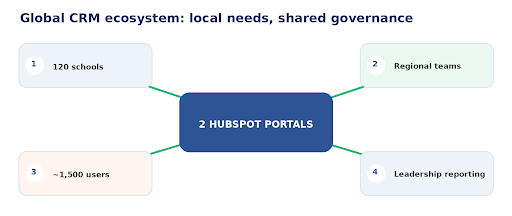
Figure 1. ISP's two HubSpot portals connect schools, regional teams, users, and leadership reporting within a governed operating model.
Founded in 2013 and headquartered in the United Kingdom, International Schools Partnership owns and operates a network of private international schools across more than 25 countries. ISP partners with schools to support high-quality learning while preserving the identity, culture, and context that make each school distinctive.
That combination of global scale and local individuality creates a demanding environment. Processes must support governance and efficiency across the group, yet remain flexible enough for different schools, regions, and teams. HubSpot supports marketing, sales, customer service, customer success, operations, finance, leadership, and IT.
As the platform's reach increased, so did the need for responsive administration, sound technical governance, reliable integrations, and continuous optimization. ISP needed a partner that could understand the broader business context as well as execute individual requests accurately and quickly.
The Business Challenge
ISP's rapid international growth placed increasing pressure on its CRM operations. CRM managers in different regions needed expert support to configure and optimize HubSpot for new requirements, but those requirements emerged from multiple teams, time zones, and operating contexts. Without a coordinated support model, there was a risk of fragmented configuration, inconsistent processes, duplicated effort, avoidable manual work, and uneven user experiences.
The core challenge was to balance global consistency with regional flexibility. Teams needed custom properties and objects, workflows, reports, dashboards, views, record layouts, pipeline enhancements, forms, landing pages, and marketing emails. HubSpot also had to exchange information reliably with other systems. Because each request could affect data, permissions, reporting, or integrations, changes had to be managed as part of a connected ecosystem rather than as isolated tickets.
ISP also required ongoing administration. Contacts and deals were periodically imported from spreadsheets, involving thousands of records over time. Users needed appropriate access through managed teams and permissions. Stakeholders expected quick turnaround, while the environment demanded disciplined testing and governance.
The engagement therefore had to solve four connected problems:
| # | Challenge | Business Risk | Inboundsys Response |
|---|---|---|---|
| 01 | Global support | Requests across regions, teams, and time zones | Dedicated HubSpot expert pool |
| 02 | Consistency | Risk of fragmented processes and configurations | Governed standards with regional flexibility |
| 03 | Manual effort | Recurring administration, imports, routing, and updates | Automation, integrations, and structured data |
| 04 | Scalability | More users, schools, systems, and evolving needs | Continuous optimization across two portals |
Project Objectives
| Focus area | Business objective | Delivery approach |
|---|---|---|
| Customer data | Centralize information and improve data accuracy | Governed CRM architecture and recurring imports |
| Revenue operations | Improve lead management, response, productivity, and forecasting | Pipelines, routing, statuses, tasks, and automation |
| Marketing + service | Automate engagement and improve customer experience | Forms, landing pages, emails, nurturing, and onboarding workflows |
| Leadership | Improve reporting, dashboards, visibility, and decision support | Centralized reports using shared definitions |
| Scale | Reduce manual work and support continued global growth | Managed support, integrations, governance, and continuous optimization |
The partnership was designed around a broad set of business and operational goals. ISP wanted to centralize customer data, strengthen lead management, increase sales productivity, automate marketing activity, and improve reporting and dashboards. It also wanted more consistent sales processes, better customer service, stronger forecasting, higher user adoption, lower administrative effort, and an operating model capable of supporting continued growth.
These objectives required more than maintaining the status quo. HubSpot needed to evolve continuously. Every configuration, automation, and integration had to contribute to a platform that was easier to use, more reliable, more visible to leadership, and more adaptable for schools and regional teams.
Discovery, Process Mapping, and Solution Design
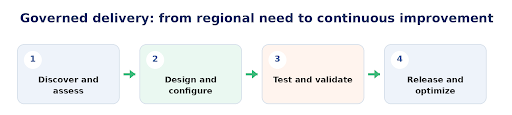
Figure 2. Every enhancement moves through discovery, architecture, validation, and controlled release.
Discovery workshops and process mapping helped Inboundsys understand how ISP users worked, where information moved, which manual steps created friction, and how proposed changes could affect the CRM.
As requirements change, Inboundsys evaluates each request within the existing architecture, identifies dependencies, defines the right configuration or development path, and validates the solution before release.
The delivery process combines solution architecture, configuration, integration development, testing, user acceptance testing, and maintenance. Close stakeholder engagement helps clarify complex requirements early, reduce rework, and keep delivery moving despite time-zone differences and tight timelines.
The HubSpot Enterprise Solution
| Capability | What Inboundsys Manages |
|---|---|
| Governance | Users, teams, permissions, properties, custom objects, record layouts, and views |
| Marketing | Forms, landing pages, marketing emails, nurturing, scoring, and lifecycle automation |
| Sales | Pipelines, lead routing, task creation, notifications, deal-stage actions, and forecasting support |
| Service + success | Customer onboarding, follow-up processes, structured records, and service enablement |
| Data + reporting | Imports, cleanup, dashboards, shared definitions, and operational visibility |
| Development | Custom-coded workflows and integrations with iSAMS, Ravenna, and the wider technology ecosystem |
Inboundsys provides end-to-end CRM management across ISP's HubSpot Enterprise environment. The work spans Marketing Hub, Sales Hub, Service Hub, Data Hub/Operations Hub, and Smart CRM, serving teams across marketing, sales, customer service, customer success, operations, finance, leadership, and IT.
CRM architecture, administration, and governance
At the foundation is structured CRM administration. Inboundsys manages users, teams, and permissions across a large user base. The team configures custom properties and objects, manages lifecycle stages and lead statuses, develops sales pipelines, and creates custom views and record layouts that help users work efficiently.
This governance is essential at ISP's scale. Changes that appear small can influence multiple teams, workflows, reports, or integrated systems. By retaining knowledge of the portals and ISP's business processes, the dedicated team can assess consequences before implementation and help maintain consistency over time.
Marketing, sales, and service enablement
The solution supports work across the customer journey. Inboundsys builds and maintains forms, landing pages, and marketing emails, while configuring workflows that improve lead management. Sales teams benefit from structured pipelines, standardized stages, automated tasks, lead routing, notifications, and clearer record layouts. Service teams gain processes that support onboarding and follow-up.
The objective is not automation for its own sake. Each improvement is designed to remove unnecessary effort, accelerate response, improve data quality, and help teams follow agreed processes without adding administrative burden.
Workflow automation and custom-coded logic
Automation is a major part of the platform's ongoing evolution. Inboundsys has implemented workflows for lead assignment, lifecycle-stage updates, task creation, internal notifications, deal-stage actions, lead nurturing, customer onboarding, data cleanup, and lead scoring. Where standard workflow actions are not sufficient, custom-coded automation extends HubSpot to meet more complex requirements.
These automations reduce repetitive manual steps and make processes easier to scale. As activity increases, the CRM can route, update, notify, and validate consistently without a proportional increase in administration.
Reporting and operational visibility
Inboundsys develops reports and dashboards that give CRM managers and leadership greater visibility into operations and performance. Centralized reporting helps teams monitor activity using shared definitions and reduces the effort required to assemble information manually from disconnected sources. Reporting is treated as an ongoing capability. Dashboards are refined as processes change and stakeholder questions emerge, giving ISP a stronger foundation for oversight, forecasting, and continuous improvement.
Custom Integrations with iSAMS and Ravenna

Figure 3. Stage-based creation and subsequent synchronization reduce re-entry and help both systems remain current.
ISP's CRM does not operate in isolation. Inboundsys supports custom application integrations connecting HubSpot with systems including iSAMS and Ravenna, using Node.js and PHP alongside HubSpot Enterprise.
One of the most valuable workflows connects HubSpot with iSAMS. When a record reaches a defined stage in HubSpot, the integration automatically creates the corresponding record in iSAMS. Subsequent updates made in HubSpot are synchronized with iSAMS so that both platforms remain current.
This integration replaces avoidable re-entry, reduces the risk of discrepancies between systems, and creates a more reliable flow of information. It demonstrates an important principle of the engagement:
HubSpot is managed as part of ISP's wider technology ecosystem. Configuration, data, automation, and integrations are designed together so that teams can work across platforms with greater confidence.
Ongoing Data Management
Although the engagement did not involve a single large-scale migration, it includes limited, recurring imports of contacts and deals, typically from spreadsheets. Across the life of the partnership, these activities can involve thousands of records.
Inboundsys supports this continuous process with careful preparation and platform knowledge. Imports must align with the established data model, avoid unnecessary duplication, preserve reporting quality, and work correctly with workflows and integrations. Treating each import as part of the governed CRM environment helps ISP maintain better data accuracy as new information enters the system.
A Dedicated Global Support Model

Figure 4. A multi-disciplinary expert pool supports portal reliability, automation, integrations, and reporting.
The most distinctive aspect of the engagement is its continuity. Inboundsys did not complete a one-time setup and step away. The team operates as an extension of ISP's CRM function, providing ongoing administration, optimization, development, and support as requirements emerge.
To meet tight timelines and work with global stakeholders, Inboundsys retained a dedicated pool of HubSpot experts. This improves turnaround, protects consistency through knowledge of existing portals and business rules, and preserves institutional knowledge that would otherwise be lost through repeated discovery and handovers.
Continuous engagement with stakeholders is equally important. Clear requirement gathering, regular collaboration, structured testing, and user acceptance testing allow the team to handle complex and evolving needs while maintaining delivery quality across regions and time zones.
Overcoming Delivery Complexity
The engagement combines two enterprise portals, approximately 1,500 users, multiple departments, global teams, tight timelines, integrations, and changing requirements. Solutions must also balance organization-wide standards with regional ways of working.
Inboundsys addresses this through disciplined discovery, solution architecture, and a retained specialist team. Dependencies are evaluated before work begins, and solutions progress through testing and user acceptance testing. This supports fast response without sacrificing control.
Business Results
| Outcome area | Verified result or operational benefit |
|---|---|
| Scale | Approximately 1,500 users supported across two HubSpot enterprise portals |
| Reach | 120 schools supported across isp's global network |
| Responsiveness | Approximately 500 support requests resolved through the ongoing engagement |
| Data | Recurring imports involving thousands of contact and deal records managed over time |
| Efficiency | Less manual work through routing, tasks, notifications, lifecycle updates, and integrations |
| Visibility | More consistent reporting and dashboards for CRM managers and leadership |
| Continuity | Dedicated specialists retain portal knowledge and accelerate delivery across time zones |
The partnership has produced measurable scale and practical operational benefits: Beyond these figures, ISP has reduced manual work, improved data accuracy, accelerated lead response, strengthened marketing automation, lowered operating effort, improved the customer experience, and established more scalable processes.
CRM managers can spend more time on strategic initiatives instead of routine platform administration. Standardized processes and centralized reporting give teams better visibility into activity and performance. The dedicated support model allows new requirements to be implemented quickly while maintaining a more consistent experience across regions.
Long-Term Business Value
The engagement has helped transform HubSpot from a set of CRM tools into a strategic platform that can evolve with ISP's growth. Continuous optimization means the system can respond to new requirements without forcing the organization into repeated, disruptive reimplementation projects. ISP now has a CRM ecosystem that supports standardization while retaining regional flexibility. Automations reduce repetitive work, governance protects consistency, reporting improves oversight, and a retained team provides continuity when priorities change.
This creates lasting value because the platform is not allowed to become static. It is actively managed, reviewed, extended, and improved. As ISP's network, user community, and operational needs continue to grow, HubSpot can grow with them.
Technology Stack
HubSpot Marketing Hub Enterprise
HubSpot Sales Hub Enterprise
HubSpot Service Hub Enterprise
HubSpot Data Hub/Operations Hub Enterprise
HubSpot Smart CRM
Node.js
PHP
Custom application integrations with iSAMS and Ravenna
Spreadsheet-based imports for ongoing contact and deal data requirements
Why Inboundsys
ISP needed more than occasional technical assistance. It required a HubSpot partner capable of combining strategic CRM consulting, enterprise platform expertise, custom development, integration capability, and dependable ongoing support.
Inboundsys combines those capabilities in one delivery model. Its dedicated team understands ISP's portals and processes, collaborates across time zones, and moves from discovery through development, testing, and maintenance. This continuity helps solve immediate requirements while protecting the CRM ecosystem.
For a global organization, that continuity matters. It turns support from a reactive ticket-handling function into an ongoing partnership focused on adoption, efficiency, consistency, and scalable growth.
Conclusion
International Schools Partnership's HubSpot environment must serve a global community while meeting the needs of schools and regional teams. Through CRM management, automation, reporting, governance, and integrations, Inboundsys has helped ISP balance those priorities.
The outcome is a scalable enterprise CRM ecosystem supporting approximately 1,500 users across two portals and 120 schools. With around 500 support requests resolved and continuous enhancements delivered, ISP's CRM managers can focus on business outcomes while Inboundsys helps keep the platform reliable, connected, and ready for what comes next.
READY TO SCALE YOUR HUBSPOT OPERATION?
Is your HubSpot portal becoming harder to manage as your organization grows? Inboundsys can help you standardize processes, automate manual work, build reliable integrations, improve reporting, and provide the ongoing expertise your teams need. Talk to Inboundsys about enterprise HubSpot implementation and managed CRM support.