
Engagement at a glance
Client
Granite Transformations (Trend Group)
Industry
Home renovation and franchise operations
Engagement
Enterprise onboarding, implementation, migration, automation, and custom workflows
Platform
Marketing, sales, service, content, and operations hub enterprise
Executive summary
Managing customer relationships across a multi-franchise organization requires more than a conventional CRM. Every inquiry must reach the correct location, every sales opportunity must follow a consistent process, and leadership needs reliable visibility across the network. When customer data and workflows are fragmented across systems, growth increases complexity instead of creating scale.
Granite Transformations, a home renovation business specializing in kitchen and bathroom remodeling, faced this challenge across 17 franchise locations. Customer information was spread across Zoho CRM and legacy tools; lead assignment depended on manual coordination; and individual franchises followed different sales and production processes. Marketing, sales, service, and operations teams lacked a unified view of the customer journey.
Granite Transformations partnered with Inboundsys to implement a comprehensive HubSpot Enterprise ecosystem spanningMarketing Hub, Sales Hub, Service Hub, Content Hub, and Operations Hub. The engagement was designed as a business transformation initiative rather than a simple CRM deployment. Inboundsys created a centralized operating platform with automated lead routing, franchise-specific pipelines, role-based access, custom workflows, reporting, and a product ordering process for franchisees.
The implementation centralized approximately 5,000 contact records, standardized sales and production processes across 17 franchises, and enabled 100% of new consultation leads to be routed automatically to the appropriate franchise and contact owner. The resulting platform gives Granite Transformations a scalable foundation for growth, stronger operational control, and a more consistent customer experience.
About Granite Transformations
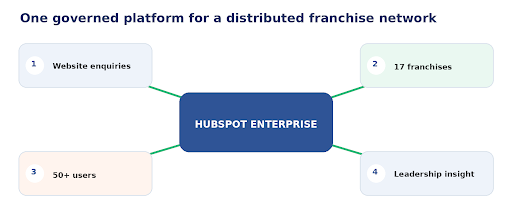
Figure 1. HubSpot Enterprise connects website demand, franchise execution, users, and leadership visibility.
Granite Transformations is an established home renovation company offering premium kitchen and bathroom remodeling solutions. Its services include countertop and surface installations, cabinet refacing, mosaic tiles, and related improvements designed to create attractive, durable spaces with less disruption than conventional renovation methods.
The company operates through a franchise model. Local teams manage consultations, opportunities, production activities, and customer relationships while representing a shared brand. This operating model supports regional reach and customer proximity, but it also creates a demanding technology environment. The central organization needs common standards and visibility, while individual franchises require workflows that reflect their day-to-day
responsibilities.
As the network expanded, disconnected tools and inconsistent processes made it harder to manage leads, compare franchise performance, and maintain a reliable view of each customer. Granite Transformations therefore needed an enterprise platform capable of combining standardization with controlled flexibility. HubSpot Enterprise was selected as the foundation, and Inboundsys was engaged to translate business requirements into a scalable CRM and automation architecture.
The Business Challenge
| # | Challenge | Business Effect | Design Response |
|---|---|---|---|
| 01 | Fragmented systems | Customer history spread across Zoho CRM and legacy tools | Centralized enterprise CRM |
| 02 | Manual routing | Slower assignment and risk of sending enquiries to the wrong franchise | Rules-based routing and ownership |
| 03 | Process variation | Different sales and production practices across locations | Standardized franchise pipelines |
| 04 | Limited visibility | Manual reporting and weak cross-franchise comparison | Shared dashboards and governance |
Before the project, customer and operational information was distributed across Zoho CRM and other legacy systems. Different teams often worked with different records and processes, limiting collaboration and making it difficult to maintain a complete customer history.
Lead distribution was one of the most critical pain points. Consultation requests submitted through the website had to be reviewed and assigned manually. Each request needed to reach the correct franchise based on the available information, then be assigned to an appropriate owner and entered the right pipeline. Manual handling increased response time created opportunities for incorrect routing and became more difficult to manage as enquiry volumes grew.
Sales and production processes also varied between locations. Without standardized pipelines, leadership could not easily compare activity, forecast performance, or establish consistent operational practices. Marketing automation was limited, reporting required additional manual effort, and teams lacked a shared system connecting the complete journey from initial enquiry through sales, production, and service.
The challenge was therefore not simply to replace an existing CRM. Granite Transformations needed to redesign how information moved through the organization and create a platform that could support multiple franchises without sacrificing governance, visibility, or user adoption. The engagement therefore needed to solve four connected problems.
Project Objectives
Centralize customer, franchise, sales, service, and operational information in one governed platform.
Route every new consultation enquiry to the correct franchise, contact owner, and pipeline automatically.
Standardize sales and production stages while preserving practical franchise-level working views.
Automate repetitive updates, notifications, tasks, ownership changes, and stage-based actions.
Strengthen dashboards, forecasting, and cross-franchise performance visibility.
Create an extensible foundation for future integrations, reporting needs, and franchise growth.
Discovery, Process Mapping, and Solution Design
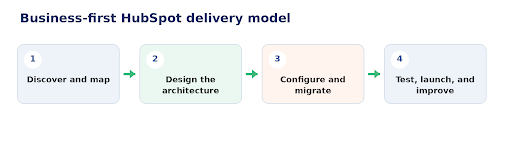
Figure 2. A controlled delivery sequence connected business requirements, architecture, migration, testing, and adoption.
Inboundsys began with discovery workshops and process mapping across relevant business functions. The team examined how enquiries entered the organization, how franchise locations were identified, how opportunities progressed, how production activities were managed, and where manual steps or inconsistent practices created friction.
The discovery phase also covered data structure, user roles, permissions, lifecycle stages, lead statuses, reporting requirements, integration needs, and migration constraints. Instead of reproducing legacy processes inside HubSpot, Inboundsys assessed which steps should be standardized, automated, simplified, or redesigned.
This business-first approach shaped the solution architecture. Each proposed property, pipeline, workflow, and permission rule was evaluated as part of the wider operating model. That helped reduce duplication, protect data quality, and ensure that the platform could serve both central leadership and individual franchise teams.
The HubSpot Enterprise Solution
| Capability | What Inboundsys Built |
|---|---|
| CRM + governance | Users, teams, permissions, properties, lifecycle stages, lead statuses, layouts, and views |
| Marketing | Forms, landing pages, marketing email, lead capture, and nurturing foundation |
| Sales + production | Franchise-specific pipelines with shared stage definitions and ownership rules |
| Operations | Routing, notifications, tasks, data updates, stage actions, and product ordering |
| Reporting | Dashboards for lead flow, pipeline activity, franchise performance, and operational progress |

Figure 3. Marketing, sales, production, and operations work through connected HubSpot capabilities.
Inboundsys implemented an integrated HubSpot Enterprise environment spanning Marketing Hub, Sales Hub, Service Hub, Content Hub, and Operations Hub. Together, these products created a connected platform for customer acquisition, sales execution, operational workflows, service processes, content, automation, and reporting.
The solution was organized around a simple principle: capture each enquiry once, enrich and route it automatically, give the correct franchise a structured process for follow-up, and provide leadership with centralized visibility.
CRM foundation and governance
Inboundsys configured users, teams, role-based permissions, custom properties, lifecycle stages, lead statuses, record layouts, and custom views. This governance layer ensured that more than 50 users could work efficiently while accessing only the information relevant to their roles.
Marketing and lead capture
HubSpot forms, landing pages, and marketing capabilities were configured to capture consultation requests and support future nurturing. Each submission enters the CRM in a structured format that can be evaluated by automation.
Sales and production pipelines
Customized sales and production pipelines were created for all 17 franchise locations. Standard stages and definitions improved consistency, while franchise-specific structures gave local teams a practical workspace for managing opportunities and operational progress.
Operations and automation
Operations Hub and HubSpot workflows supported data management, routing, notifications, task creation, ownership, and stage-based actions. Automation reduced administrative effort and made the operating model easier to scale.
Reporting and dashboards
Dashboards and reports were designed to improve visibility into lead flow, pipeline activity, franchise performance, and operational progress. Centralized reporting reduced the need to assemble information manually from multiple tools.
Custom Engineering for Franchise Operations

Figure 4. New consultation enquiries enter a repeatable path from capture to franchise assignment and follow-up.
Master lead-routing workflow
The centerpiece of the solution is a custom lead-routing process for website consultation requests. When a new enquiry enters HubSpot, the workflow evaluates the available information, identifies the correct franchise, creates or updates the associated records, assigns the relevant contact owner, creates a deal, routes it into the correct pipeline, and triggers internal notifications and follow-up actions. This process replaced manual coordination and ensured that every new consultation lead entered a controlled, repeatable path.
Franchise-specific operating model
Supporting 17 franchises inside one enterprise platform required a careful balance between standardization and local usability. Inboundsys designed consistent pipeline stages and common data definitions while configuring team structures, views, permissions, and ownership rules that allowed each franchise to focus on its own records.
Centralized product ordering
Inboundsys also developed a centralized product ordering process for franchisees. The solution gives authorized users a structured way to submit and manage product requirements while maintaining role-based controls. This extended HubSpot beyond lead management and demonstrated how the platform could support broader operational workflows.
Workflow automation
Additional workflows were configured for record updates, task creation, notifications, ownership, lifecycle management, stage actions, and data quality. These automations reduce repetitive work and help users follow agreed processes without relying on memory or manual coordination.
Data Migration and Platform Configuration
Approximately 5,000 customer contact records were prepared and migrated from Zoho CRM and legacy sources into HubSpot. Migration involved more than transferring rows between systems. Records needed to align with the new data model, avoid unnecessary duplication, preserve useful history, and work correctly with ownership, workflows, reporting, and franchise assignment rules.
Inboundsys configured custom properties and objects, users and teams, lifecycle stages, lead statuses, forms, marketing emails, workflows, products, quotes, and payment-related capabilities. Data and configuration were tested together so that migrated records would behave correctly within the new operating environment.
The broader solution was also planned to support connections with systems and communication tools including QuickBooks, Zoom, WhatsApp, and Google Meet. Where integrations were planned or phased, the architecture was designed to accommodate them without undermining the CRM foundation.
Overcoming Delivery Complexity
The project combined legacy data, multiple franchise locations, more than 50 users, changing requirements, tight timelines, API constraints, and the need for consistent reporting. A change that benefited one location could affect permissions, workflows, data, or dashboards elsewhere, so isolated configuration decisions were not sufficient.
Inboundsys addressed this complexity through structured discovery, solution architecture, staged delivery, testing, and user acceptance testing. Requirements were assessed within the complete CRM ecosystem, dependencies were identified early, and changes were validated before release. Close collaboration with stakeholders helped the team refine requirements while protecting the integrity of the wider solution.
This disciplined approach allowed the project to move forward without losing sight of the long-term goal: a platform that is reliable today and adaptable as the franchise network evolves.
Business Results
| Outcome Area | Verified Operational Improvement |
|---|---|
| Data | Approximately 5,000 contacts brought into a centralized CRM foundation |
| Lead response | Every new consultation request automatically evaluated and routed to the appropriate franchise and owner |
| Process | Sales and production pipelines standardized across 17 franchise locations |
| Governance | More than 50 users supported through teams, permissions, ownership, views, and common definitions |
| Operations | Centralized product ordering and repeatable workflow automation reduce manual coordination |
| Visibility | Dashboards provide a clearer view of lead flow, pipeline activity, franchise performance, and progress |
The implementation created a centralized CRM and operational environment for Granite Transformations. Customer information is now managed within a shared platform, and franchise teams can follow structured processes instead of relying on disconnected tools or local workarounds.
All new consultation requests are automatically evaluated and routed to the appropriate franchise and contact owner. Seventeen franchise locations now use standardized sales and production pipelines, improving consistency and giving leadership a stronger basis for comparison and forecasting. Approximately 5,000 contacts have been brought into the new CRM foundation, reducing fragmentation and improving accessibility of customer information.
The solution has also reduced manual lead assignment, improved visibility, supported better CRM adoption, strengthened marketing automation, and created a centralized product ordering process with controlled access. These improvements help teams respond faster, maintain cleaner data, and spend less time on routine administration.
Most importantly, Granite Transformations now has a platform that can scale. New workflows, reports, integrations, and franchise requirements can be added within a governed architecture instead of creating another layer of disconnected systems.
Long-Term Business Value
The long-term value of the project lies in the operating model created around HubSpot. The organization has moved from fragmented tools and inconsistent processes toward a managed enterprise ecosystem connecting marketing, sales, service, and franchise operations.
Automation allows enquiry volumes to increase without requiring a proportional increase in manual coordination. Standardized pipelines support consistent execution, while dashboards provide leadership with clearer oversight. Role-based governance protects data and makes the platform practical for a distributed user community.
Because the architecture was designed for extension, Granite Transformations can continue introducing new integrations, reporting requirements, automation, and franchise processes without rebuilding the core CRM. HubSpot has become a scalable digital foundation rather than a static database.
Technology Stack
HubSpot Marketing Hub Enterprise
HubSpot Sales Hub Enterprise
HubSpot Service Hub Enterprise
HubSpot Content Hub Enterprise
HubSpot Operations Hub Enterprise
HubSpot workflows and custom automation
Zoho CRM and legacy-source migration
Planned integrations including QuickBooks, Zoom, WhatsApp, and Google Meet
Why Inboundsys
Granite Transformations required more than standard HubSpot onboarding. The project demanded process consulting, enterprise CRM architecture, data migration, complex automation, franchise-aware governance, and custom operational workflows.
Inboundsys combined those capabilities within one delivery model. The team moved from discovery and process mapping through configuration, custom engineering, migration, testing, and optimization. This continuity helped preserve business context and ensured that individual features contributed to a coherent platform. The engagement demonstrates the value of treating CRM implementation as business transformation. By understanding how the franchise network operated and designing HubSpot around those realities, Inboundsys delivered a solution that supports immediate efficiency while creating room for future growth.
Conclusion
Granite Transformations needed to unify customer data, automate lead assignment, standardize franchise processes, and improve operational visibility. Through HubSpot Enterprise, Inboundsys created a connected platform serving 17 franchise locations and more than 50 users, with approximately 5,000 contacts migrated and every new consultation lead routed automatically.
The outcome is more than a replacement CRM. It is a scalable operating environment connecting marketing, sales, production, service, and franchise workflows. With clearer governance, reduced manual effort, and a foundation for continued enhancement, Granite Transformations is better positioned to grow while delivering a more consistent customer experience.
READY TO SCALE YOUR HUBSPOT OPERATIONS?
Is your CRM becoming harder to manage as your organization grows? Inboundsys can help you centralize data, automate manual work, standardize processes, build reliable integrations, and create a scalable HubSpot ecosystem. Talk to our HubSpot experts about your next implementation.